- Home
-
Our Products
- Intensive Care Unit Equipment for Hospitals ( ICU)
- Operation Theatre Equipment for Hospitals (OT)
- Neonatal ICU Equipment for Hospitals
- Labour Room Equipment for Maternity Care
- Emergency Room Equipment for Hospitals
- Inpatient Ward Equipment for Hospitals
- OPD Consultation Equipment for Clinics
- Mobility Aids for Patient Support & Rehabilitation
- Diagnostic Imaging Equipment for Hospitals
- Diagnostic Lab Equipment for Medical Testing
- Sterilization Equipment for Healthcare Facilities
- Contact Us
- About Us
- Blogs

Immunology
-
Product is not available
Brand:
Country Of Origin : India
Assay Menu & Testing Methodology
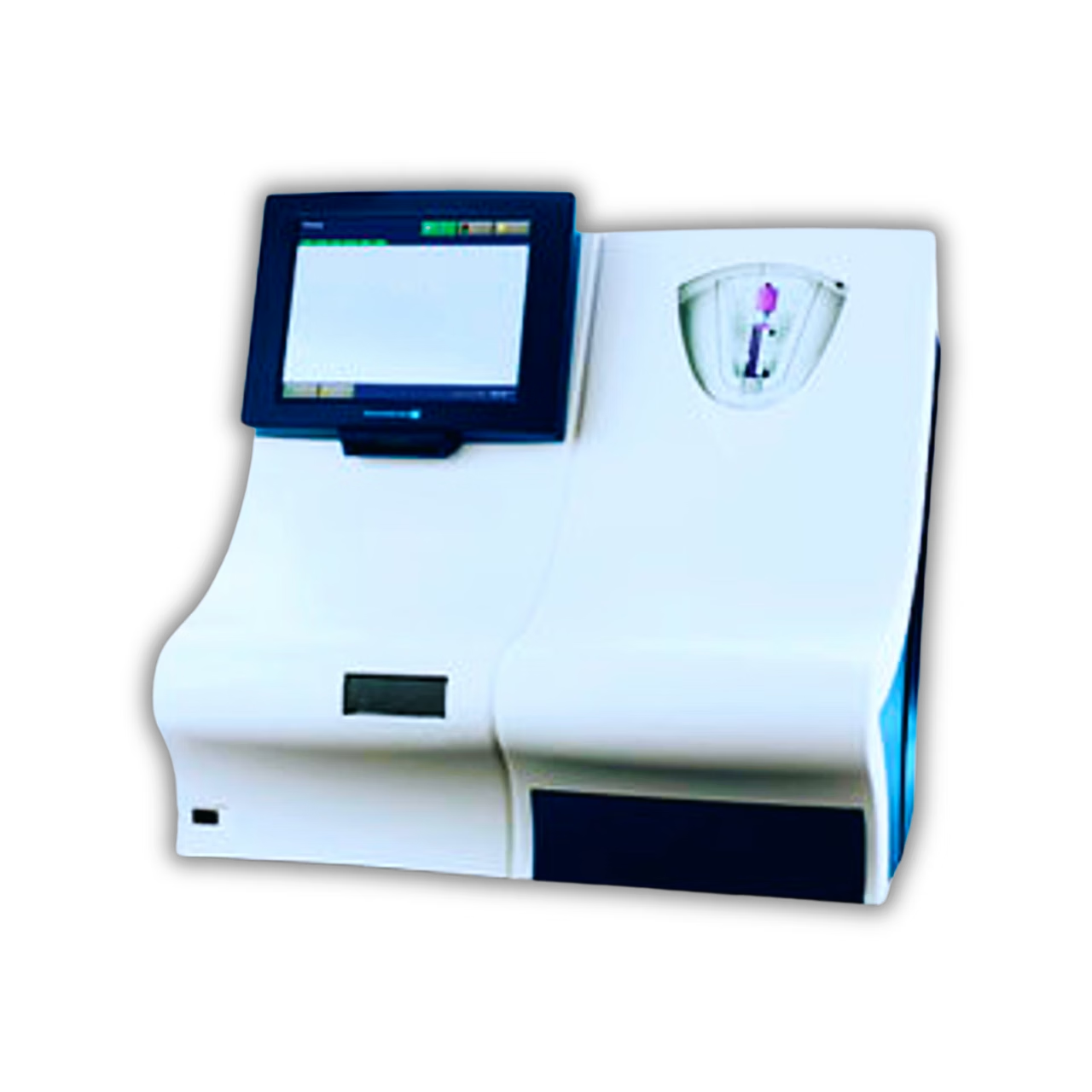
Immunology Analyzer designed for clinical laboratories offering chemiluminescence or ELISA-based assays. Assay menu supports common immunoassays for infectious disease markers and hormonal panels. Analyzer options include single or multi-channel reagent handling and automated pipetting for reduced manual steps.
Throughput (Tests/Hour) & Reagent Ecosystem
Throughput varies by model and assay complexity; select models focus on high-throughput screening while compact systems serve medium-volume labs. Reagent ecosystem may be closed or open; closed systems require validated kits while open platforms accept third-party reagents subject to validation. Consider reagent shelf-life and onboard refrigeration where applicable.
Sample Loading & LIS/HL7 Integration
Analyzers support sample racks and barcoded tracking for throughput and traceability. Bidirectional LIS/HL7 integration allows order/result flow to central laboratory information systems. Sample capacity and STAT lanes determine workflow suitability for emergency and routine testing.
Calibration, QC, and Maintenance Cycles
Calibration frequency depends on assay classes and reagent stability; daily QC and scheduled maintenance preserve analytical performance. Service contracts can include preventive maintenance and reagent management. Labs should plan validation runs and lot-to-lot verification when adopting new reagent lots.
Frequently Asked Questions
- What are bulk ordering terms for immunology analyzers? Bulk procurement is supported with reagent and service bundling for high-volume labs. (moq_bulk_order)
- How is pricing influenced by assay menu and open/closed reagent systems? Pricing increases with broader assay menus and closed-system reagents; open systems may lower consumable costs but require validation. (pricing_cost)
- What integration standards are supported? Systems commonly support HL7/LIS bidirectional interfaces for automated order/result exchange. (certifications_compliance)
- How are analyzers shipped and installed? Units ship with installation kits; installation includes calibration, validation runs, and connectivity setup. (logistics_delivery)